Colectiva de Mujeres por la Salud de la Sierra
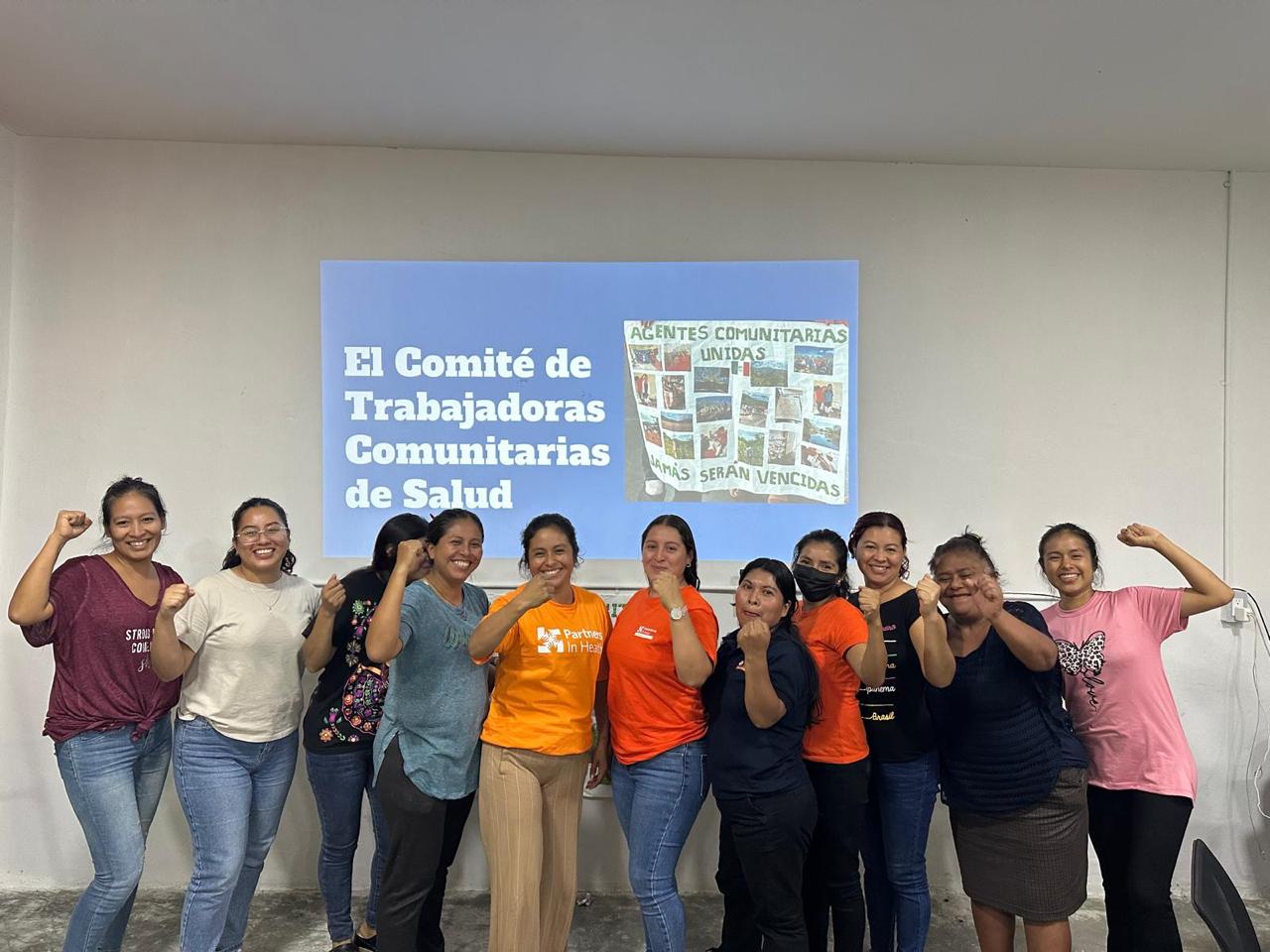
Nine campesina women and community health workers from the Sierra Mariscal of Chiapas, Mexico.
Who We Are
“We fight for health, supporting people of few means, seeking the well-being of the community. […] We consider ourselves the voice of the patients.”
We are the Union of Women for the Health of the Sierra. We are nine women from different communities in the Sierra Mariscal of Chiapas, Mexico: Laguna del Cofre, Capitán, Salinas, Plan Baja, Salvador Urbina, Reforma, San Rafael, and others. We are campesina women, and we are community health workers. For years we accompanied our neighbors through chronic illness, mental health conditions, and pregnancy, and we continue to do that work now on our own.
We came together to help people in our own communities who live with chronic disease or mental health conditions. We fight for health, we support people of few means, and we seek the well-being of everyone in our communities. Today our work is concentrated in two efforts: a medicinal garden, and a small community pharmacy we are trying to build.
We would like to help everyone. But we are starting with nine communities, and we intend to open to more communities as we grow, weighing both the distance between us and the need of each new community in our decision to expand.
Our History
Our work began at a moment when we felt isolated and without a voice.
All of us worked as community health workers in the field for Partners In Health, an international NGO founded by Paul Farmer.
The work itself started with volunteering: caring for people with chronic conditions, with mental health needs, with the risks of pregnancy and birth. Some of our compañeras gave thirteen years to this work. Many of us spent years as volunteers, carrying real responsibility and facing real difficulty before we were ever acknowledged for our work.
We belonged to Compañeros En Salud, and what we needed was to help carry that organization forward, which meant raising our voices inside it. We fought for the continuation of the work for our communities. We organized and represented the voices of the patients who were at risk of losing their access to care. Out of this fight, our collective was born.
The Moment We Find Ourselves In
“We have a story, each one of us as community workers; what we lack is the money, the resources to start another project.”
Following the global health funding crisis, medications stopped being stocked. The accompaniment we used to provide ceased to exist. People now arrive at the clinic and find no medicine and no supply, so they are forced to buy it themselves, and right now medicines are expensive. We are seeing the consequences: uncontrolled blood sugar, uncontrolled blood pressure, mental health crises. Controlled medications are badly needed. Mental health treatment is badly needed.
Contraception has disappeared, and for many women here that is not a small thing: there are women whose partners want only more children, women who have lived with domestic violence, women who were using contraception without their husbands knowing. They come to the clinic, and there is nothing. That is creating real anxiety and crisis.
People come to us instead, but we now have nothing left to support them with.
What We Seek for the Future
We want to help our community through a project that is sustained by our own initiative, our own hands. That is the heart of our fiscal need. But we believe there are several practical ways we can achieve that at first.
A mini-pharmacy in each community
We want to stock and sell essential medications at low cost, filling prescriptions written by the physicians at the clinic. Where the clinic cannot supply the medicine, we would. This alone would spare people the journey to Jaltenango and the 3,000 pesos it costs.
We would operate not for profit, but at a fair price, enough to maintain the service. For people who cannot pay, we envision barter: free-range chickens, coffee, beans, corn, which we would then sell. That way the person gets their medicine, and the collective gets food that it can also bring to the market. If we secure enough funding, we would even be able to give medication free to those who have nothing at all.
The same logic extends to care itself. Rather than a family paying for a psychologist in another town, our mental health caregivers can already be there.
A medicinal garden
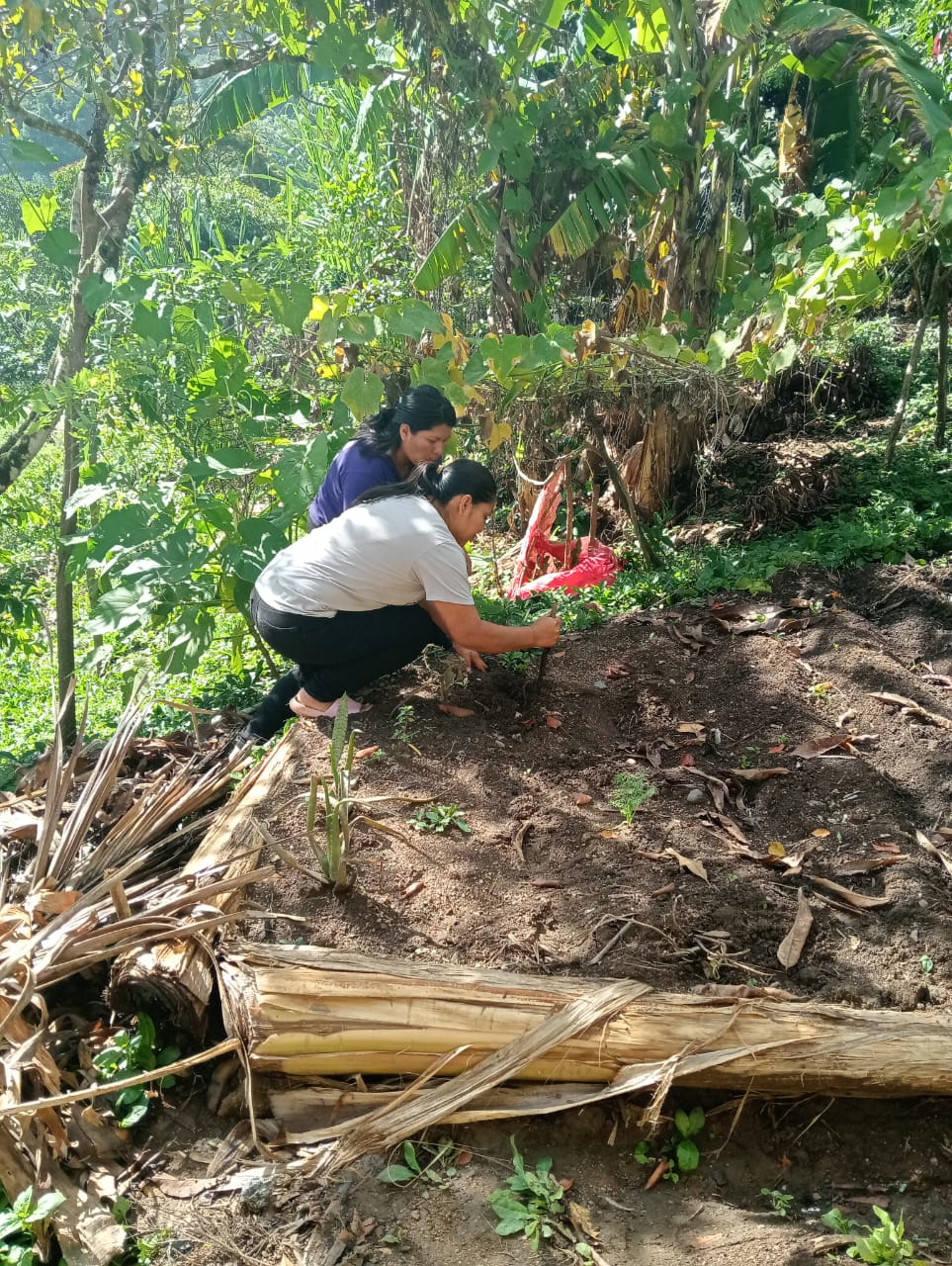
We are planting in each of our communities. The purpose is to make our own medicine, to manage conditions if not to cure them, working both sides at once: pharmaceutical medicine and traditional medicine, together with good nutrition.
From the garden we want to produce tinctures for sale and medicinal plants, and to properly cultivate the herbs that already grow in our communities. Alongside them we are planting radishes, cilantro, and other food crops, so the garden brings in a little income and feeds us while it grows.
The garden is also something else. Planting with our own hands helps us release our stress together.
Growing on our own terms
We meet every week. We want to add in-person gatherings every two months to track how the project is advancing across each of the nine communities.
Some of our compañeras are receiving training from another organization, and they bring everything they learn back to the group so that all of us can move forward. We are moving little by little, with the force that comes from doing good and sowing seeds that can grow exponentially in each community.
Our Greatest Needs
What we need most
- Income. None of us has a salary right now, and each of us has a family depending on her.
- Materials to build the medicinal garden.
- Stock and supplies for the mini-pharmacy.
- Guidance: someone to advise us on which medications to carry and how to manage them properly.
- A wound care kit. We know how to do this work; we simply no longer have the materials. We need gauze (sterile and non-sterile), lidocaine, injectable solutions, hydrogen peroxide, alcohol, nylon suture 3-0 and 4-0, gloves, bandages, and silver sulfadiazine. And a first aid kit.
- Insulin, which is missing here entirely.
The Challenges We Face
Money
The first and hardest question is simply where the funds come from.
Ourselves
We are honest about this. Some of us work more and some less, and that discourages us. Some of us want to move forward while others fall back. Holding nine women together after what we went through is its own work.
Insecurity
The violence in our communities has not gone away. It is still here, and we live with its weight.
Water and land
The rains have failed. We are short of water, and the soil we want to plant in is degraded. These are not abstract obstacles; they are the difference between a garden that produces and one that does not.
The Resources and Support We Need
A place to work. A stable location for the pharmacy, whether a space we hold or one we rent, along with basic furnishings: a table, shelves for the medications, and a computer.
Startup capital. Our estimate is approximately 100,000 pesos (almost 6,000 USD) per member to launch:
With that capital we can stock the medications people actually need, open a real space, and get to work, and from there sustain ourselves through sales, barter, and the garden.
Help the Colectiva sow what they have started
Every contribution goes to nine women rebuilding care in their own communities: medicines, a garden, and a pharmacy sustained by their own hands.
Donate to the Colectiva